
Last modified: 2026-06-06 by ian macdonald
Keywords: sassanian empire | iran |
Links: FOTW homepage |
search |
disclaimer and copyright |
write us |
mirrors
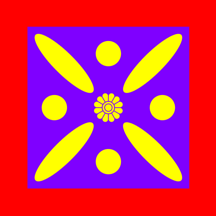 image located by William Garrison, 2
April 2026
image located by William Garrison, 2
April 2026See also:
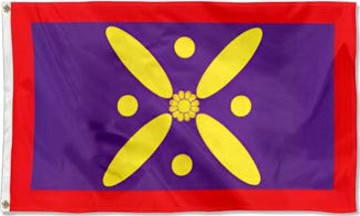
The purported flag of the "Sassanian Empire" that existed between 224 to 651
CE in Iran/Persia. Wikipedia lists this flag as a "Derafsh Kaviani" or
"'Standard of Kaveh". The "Kaveh" being "Kaveh the Blacksmith" or "Kaveh
Ahangar" who is a figure in Iranian mythology, who leads an uprising against a
ruthless foreign ruler, Zahāk. His story is narrated in the "Shahnameh", the
national epic of Iranians, by the 10th-century Persian poet Ferdowsi. Per:
https://en.wikipedia.org/wiki/Derafsh_Kaviani#History and
https://en.wikipedia.org/wiki/Kaveh_the_Blacksmith
An image of this
flag in a square format can be found on Wikipedia at
https://en.wikipedia.org/wiki/Sasanian_Empire
Photo of flag: archived here
William Garrison, 2 April 2026
The flag photo forwarded by Jason Saber shows a rectangular version of this flag, which can be found on various flag-ad websites, such as at https://www.etsy.com/.../sassanian-flag.
These modern depictions of Derafsh Kaviani, which appear on Wikipedia and
Wikimedia Commons with varying design details, are derived from the flags - or
maybe vexilloids - which actually predate the Sasanian era, as they were
appearing on the coins issued by the fratarakas, hereditary governors
of Persis (or Persia proper, roughly corresponding with the present-day Fars
province) in the 3rd and 2nd century BC, under the Seleucid and Arsacid
(Parthian) rule [1]. On these coins, the flags are shown as hanging from the
cross-bar on the staff which is stuck in the ground, either before an enthroned
ruler [2] or behind a temple before which the ruler is standing while praying
[3-7]. While the details of the flag are not always visible due to the bad
condition of survived coins and/or the limitations of the then minting
techniques, still several examples exist which reveal many details which were
clearly used in the modern reconstructions, although the latter are more
elaborate than the reliefs displayed on the coins - most notably, the central
flower-like device is derived from what looks like a simple disc. The modern
reconstructed images also do not include the ribbons, typically four of them,
hanging from the bottom edge and terminating with some sort of medallions or
balls [2-7], or the bird (likely an eagle) placed atop the staff [7].
Curiously, the flag disappeared from the coins by the end of the 2nd century BC,
when the fratarakas assumed the title of king, which was either granted
or approved by the Parthian emperors [8], so it was never used by the last of
them, who belonged to the Sasanian dynasty (whether they related to any of their
numerous predecessors, who may have belonged to several dynasties, is not known)
[8]. The later Sasanian emperors of all Persia also did not display it on the
coins. The frataraka standard did, however, serve as the model for the
vexilloids used in the parades during the 2,500-year celebration of the Persian
Empire [9, 10]. The history books published in Iran during the same period also
display the flags or vexilloids based on the same model [11, 12]. The modern
depictions from Wikipedia and Wikimedia
Commons do resemble all of the above,
but differ from all of them as well.
Tomislav Todorovic, 10 May 2026
Sources:
[1]
Fratarakas of Persis at Wikipedia:
https://en.wikipedia.org/wiki/Frataraka
[2] Wikimedia Commons - Coin of
Bagadates (Baydad) I, frataraka of Persis:
https://commons.wikimedia.org/wiki/File:KINGS_of_PERSIS._Bayd%C4%81d_(Bagadat)_Early_3rd_century_BC.jpg
[3] Wikimedia Commons - Coin of Bagadates (Baydad) I, frataraka
of Persis:
https://commons.wikimedia.org/wiki/File:KINGS_of_PERSIS._Bagadates_Early_3rd_century_BC.jpg
[4] Wikimedia Commons - Coin of Artaxerxes (Ardashir) I, frataraka
of Persis:
https://commons.wikimedia.org/wiki/File:KINGS_of_PERSIS._Artaxerses_(Ardaxsir)_I._Early-mid_3rd_century_BC.jpg
[5] Wikimedia Commons - Coin of Oborzos (Vahbarz), frataraka of
Persis:
https://commons.wikimedia.org/wiki/File:PERSIS._Vahbarz_(Oborzos),_governor,_c._mid_3rd_century_BC.jpg
[6] Wikimedia Commons - Coin of Autophradates (Vadfradad) I, frataraka
of Persis:
https://commons.wikimedia.org/wiki/File:Silver_tetradrachm_Iran_c._280-100_BC_The_kings_of_Persis_Vadfradad_I_coin.jpg
[7] Wikimedia Commons - Coin of Autophradates (Vadfradad) II, frataraka
of Persis:
https://commons.wikimedia.org/wiki/File:Coin_of_Vadfradad_(Autophradates)_II_of_Persis,_Istakhr_mint.jpg
[8] Kings of Persis at Wikipedia:
https://en.wikipedia.org/wiki/Kings_of_Persis
[9] Wikimedia Commons -
Photo from the 2,500-year celebration of the Persian Empire:
https://commons.wikimedia.org/wiki/File:Reconstructed_Derafsh-e_Kaviani_in_2,500-year_celebration_of_the_Persian_Empire.png
[10] Wikimedia Commons - Photo from the 2,500-year celebration of the
Persian Empire:
https://commons.wikimedia.org/wiki/File:ShahanshahiIran2500SasanianDarafshKaviani3.jpg
[11] Wikimedia Commons - Reconstruction of Derafsh Kaviani from a 1976
history book:
https://commons.wikimedia.org/wiki/File:Legendary_Banner_of_Derafshe_Kaviyani.jpg
[12] Wikimedia Commons - Reconstruction of Derafsh Kaviani from a 1976
history book:
https://commons.wikimedia.org/wiki/File:Banner_of_Derafsh_kaviani_with_Jewels.jpg
The modern reconstructions of Derafsh Kaviani, based on the images available at Wikimedia Commons, have come into use in real life, mainly among the Iranians living abroad, although there are also examples of their use in Iran. An overview of the variants with recorded use follows.
Basic Design
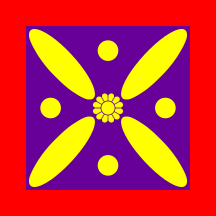 image by Tomislav Todorovic, 17
May 2026
image by Tomislav Todorovic, 17
May 2026
The basic design has four discs
between four diagonally placed ovals. It was used both in Iran (during the
protests) [1, 2] and abroad, e.g. in Australia [3], as the flag, vexilloid and
poster.
 image by Tomislav Todorovic, 17
May 2026
image by Tomislav Todorovic, 17
May 2026
A version which, according to the number of online photos, is much used by the Iranian diaspora, omits three discs, keeping only the one at the top. It is much used in the USA [4, 5, 6], but also in Austria [7], and there are also examples of its use in Iran, mainly as the
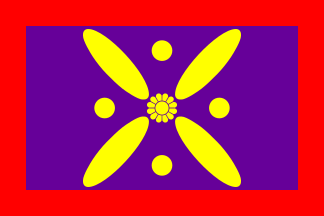 image by Tomislav Todorovic, 17
May 2026
image by Tomislav Todorovic, 17
May 2026
Rectangular version of the basic design, with the shapes of yellow/gold devices kept intact, also makes some use by the diaspora, e.g. in Norway (determined by the inscriptions on the building in the background) [8], but there are also examples of its use in Iran [2].
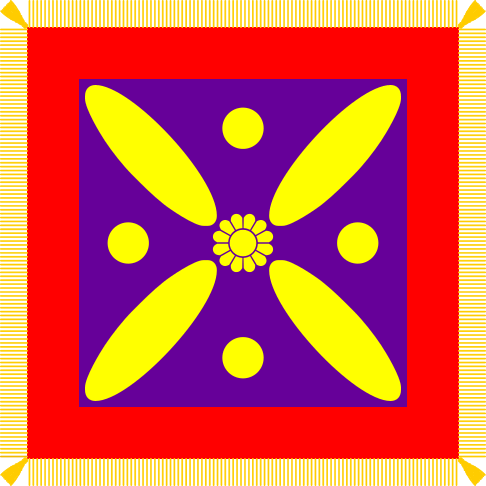 image by Tomislav Todorovic, 17
May 2026
image by Tomislav Todorovic, 17
May 2026
Lastly, a complex variant adds
the white border charged with the golden ornaments, being derived from the
image from Wikimedia Commons which actually depicts the flag with the fringes
along all four borders and tassels in the corners (a very bad case of
vexillological ignorance, but also the ignorance regarding the graphic design
in general). This one seems to be used only abroad [9, 10].
All these images are derived
from the SVG file from Wikimedia Commons:
https://commons.wikimedia.org/wiki/File:Derafsh_Kaviani
Tomislav Todorovic, 17
May 2026
Sources:
[1] Manipolitic website (WARNING: contains the photos of
murdered people):
https://manipolitic.substack.com/p/the-anatomy-of-iranian-nationalism
[2] Instagram . composite video of Iranian people displaying Derafsh Kaviani
at various locations:
https://www.instagram.com/reel/DR0LHp6Ehpb/
[3] YouTube - Video of Derafsh Kaviani used as a vexilloid in Melbourne:
https://www.youtube.com/shorts/miAj5d4BWsc
[4] PeopleOfAr website:
https://www.peopleofar.com/2019/03/27/did-the-sassanids-adopt-an-armenian-banner
[5] Center for Iranian Diaspora Studies website:
https://centerforiraniandiasporastudies.wordpress.com/2023/05/09/iranian-diaspora-spotlight-the-subject-of-objects-parmida-mostafavi-and-consumerism-within-the-iranian-diaspora-community
[6] Iransara.info website:
http://www.iransara.info/Iran%20Derafsh-e%20Kaviani%20New%20York%20Parade%20Norooz%20Persian%20Empire%20Koorosh%20Kourosh%20Padeshah%20Mullah.htm
[7] Photo of Derafsh Kaviani used in Austria at Reddit:
https://www.reddit.com/r/iran/comments/zndqle/does_anyone_know_what_flag_that_is
[8] Photo of Derafsh Kaviani used in Norway at Reddit:
https://www.reddit.com/r/vexillology/comments/yt8v24/what_flag_is_it_seen_at_an_iranian_protest
[9] Photo of Derafsh Kaviani (unknown location) at Reddit:
https://www.reddit.com/r/vexillology/comments/1nn2wxy/we_saw_this_flag_out_today_it_was_with_an_iranian
[10] N1 television channel website:
https://n1info.rs/svet/cnn-tramp-razmatra-vojnu-intervenciju-u-iranu
Tomislav Todorovic, 17 May 2026
More details of the historical Derafsh Kaviani at Pre-Islamic flags (Iran).
_Early_3rd_century_BC.jpg)

_I._Early-mid_3rd_century_BC.jpg)
,_governor,_c._mid_3rd_century_BC.jpg)

_II_of_Persis,_Istakhr_mint.jpg)


